
Fast, Reliable Spray Foam Insulation Across Chatsworth
Spray foam insulation in Chatsworth runs roughly $2,800 to $9,500 for a typical attic, with wall applications generally landing between $4,000 and $12,000 depending on square footage and whether you choose open-cell or closed-cell. Those are real numbers for this market, not national averages pulled off a website. If you live off Topanga Canyon Boulevard or in the ranch tracts near Mason Avenue, our crews know your rooflines, your venting habits, and the way Santa Ana winds push dust and embers into your attic. Call (559) 245-9223 and we’ll give you a written price before anyone picks up a tool.
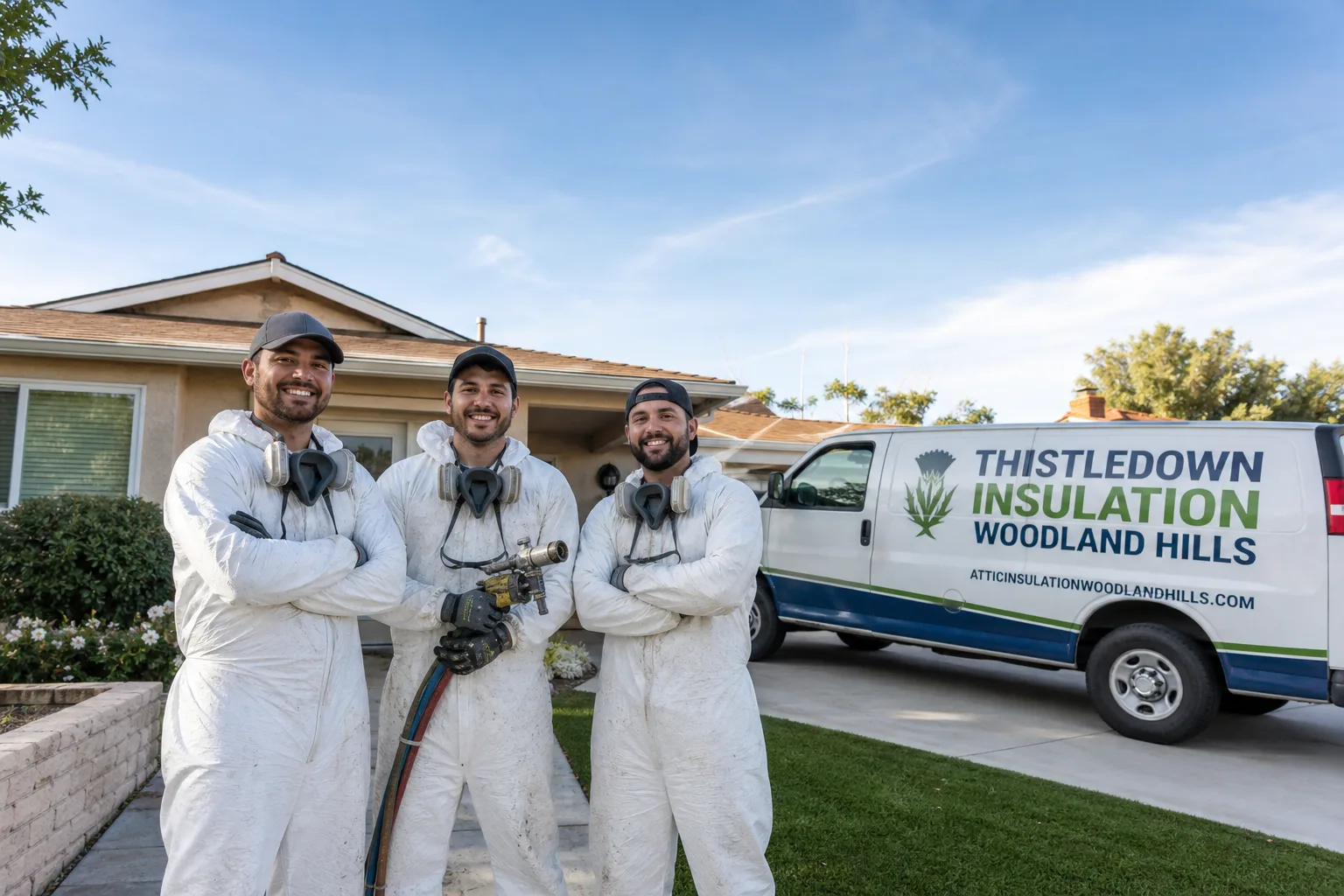
We’re part of the Cedarwell family, which means every job is bound by the 365-Day Done Right Promise and a written price before any work starts. Neil Barron leads our team, and he’s built the business since 2003 on a simple idea: treat each Chatsworth home the way we’d treat our own. That’s why we lay drop cloths across your hallway, wear shoe covers from the front door to the attic hatch, and leave a photo of the clean-up before the van pulls away.
Why Thistledown Insulation Woodland Hills Is Chatsworth’s Preferred Spray Foam Insulation Company
Chatsworth isn’t a small town, but it works like one when you need a tradesperson. People talk. Our reputation in Chatsworth comes from showing up when we say we will, giving prices that don’t creep upward mid-job, and cleaning up like it’s our own home. The Spray Foam Insulation team lives by four rules from the Cedarwell Care Promise: clean up like it’s our own home, ask before we move or touch anything, respect the family’s time and quiet hours, and explain the price before the work.
Every technician who walks through your door in Chatsworth is background-checked and wears a uniform, so you know exactly who’s upstairs while the baby naps. We answer the phone with a live person 24 hours a day, 7 days a week. No voicemail trees. If you call at 2 a.m. because a red-flag warning just went up and you’re worried about your attic, someone picks up. That’s not a marketing line; it’s how we’ve operated since 2003.
We stock material for the specific housing we see in Chatsworth, which means less waiting on parts and faster completion on everything from garage ceiling spray foam to full attic air-sealing. And because we’re an independently owned Cedarwell location, we answer to our neighbors, not a corporate office three time zones away.
Spray Foam Attic Insulation in Chatsworth
Spray Foam Attic Insulation is the single most effective upgrade for the single-story ranch and ranch-style tract homes that dominate Chatsworth, especially when the original 3-inch fiberglass batts have compacted to below R-11 after decades of heat and dust. The job involves air-sealing top plates, can lights, and any penetration from the living space, then applying foam to create a continuous thermal barrier at the roofline. In Chatsworth, that barrier does double duty: it stops the hot attic air that turns your house into an oven on 100-degree summer days, and it blocks the wind-driven dust and embers that Santa Susana Pass pushes through your roof vents every fall.
A typical attic spray foam project in Chatsworth runs $2,800 to $7,500 for a 1,200 to 2,400 square-foot home. Larger homes or attics with heavy existing contamination from dust and ember intrusion can push the number higher. You’ll get your exact written figure before any work begins.
Closed-Cell for Attic Roofline
Closed-cell foam adds structural rigidity to your roof deck at 2 to 3 inches of applied thickness and serves as an air barrier, vapor barrier, and insulation in one pass. For Chatsworth homes near Santa Susana Pass, we frequently recommend Demilec or Icynene closed-cell at the roofline because it resists the moisture that pressure-differential from Santa Ana winds can pull through roof sheathing. Where existing insulation is dusty or saturated from years of wind-driven intrusion, closed-cell seals the assembly and stops the problem at its source.
Open-Cell for Interior Comfort
Open-cell foam is a more affordable option that still delivers an air seal and significant R-value bump without the density (or price) of closed-cell. We often match Johns Manville or Icynene open-cell to attics where heat gain is the primary complaint and the roof assembly is already dry and sound. For a Chatsworth tract home with a low-slope composition shingle roof, open-cell at the roofline typically brings the attic from R-11 to R-38 or above.
Spray Foam Wall Insulation in Chatsworth
Spray Foam Wall Insulation matters most on the many Stick-frame exterior walls throughout Chatsworth’s 1950s-80s neighborhoods, where blown-in cellulose has settled below the top plate and original fiberglass has slid down inside the stud bays. When we foam an exterior wall, we’re filling the entire cavity from top plate to bottom plate, stopping the air movement that carries heat out in winter and in during summer. For Chatsworth homeowners in the 1960s-70s tracts along Mason Avenue and Winnetka Avenue, this is often the missing piece that no amount of attic work can compensate for.
Exterior wall spray foam in Chatsworth typically costs $4,000 to $12,000 depending on wall height, accessibility, and whether you have existing insulation that needs removal first. Smaller jobs, like foaming the rim joist or a single bonus room above a garage, land on the low end.
Rim Joist Air-Sealing
In Chatsworth homes with crawlspaces, the rim joist is where outside air pours into the floor system. We spray closed-cell foam into each joist bay to stop the stack effect – the upward pull that drags crawlspace air through wall cavities and into your living space. This also blocks dust and embers from collecting at the base of your framed floors during wind events.
Garage Ceiling and Bonus Rooms
Many Chatsworth ranch homes have large attached garages with bonus rooms built above them, and those spaces are often uninsulated or under-insulated. We spray garage ceiling assemblies with open- or closed-cell foam to keep adjacent bedrooms comfortable and prevent the band of hot air that radiates down through the ceiling after a long San Fernando Valley afternoon.
Trusted Brands We Service in Chatsworth
We install and service spray foam from Owens Corning, Johns Manville, Knauf, and Rockwool, matched to the specific job rather than whichever product we happen to have on the truck. For a Chatsworth attic exposed to high winds and ember intrusion, we may recommend a closed-cell Demilec product. For a straightforward re-insulation where budget is the priority, an open-cell Icynene option makes more sense. We carry the top-selling products from these brands locally, which means faster turnaround for Chatsworth customers and less time between your written estimate and the day the job is done.
Common Spray Foam Insulation Problems We See in Chatsworth Homes
- Wind-driven embers and dust intrusion through roof vents. During Santa Ana events, fine dust and occasional embers blow through unsealed gravity roof vents and settle into old fiberglass or cellulose. Over time, this contaminates the insulation and creates pockets where radiant heat still penetrates. Spray foam’s monolithic air seal stops this at the source.
- Compacted 1960s-70s fiberglass batts below R-11. We routinely find 3-inch batts in Mason Avenue tract homes that have been flattened by decades of heat and dust, lowering the effective attic R-value from R-19 to under R-11. Removing that degraded material before spraying foam is often the single biggest gain in whole-house comfort.
- Settled blown-in cellulose in exterior walls. Many Chatsworth stick-frame homes have cellulose that has settled below the top plate over 40 or 50 years, leaving a gap at the top of each wall cavity. Spray foam fills that entire cavity, eliminating the air channel that steals heat in winter and raises cooling costs in summer.
- Moisture condensation on roof sheathing in winter. When spray foam is applied without a proper thermal barrier, or when insulation is poorly sealed at top plates, cool winter nights cause warm indoor air to hit the cold underside of the roof deck and condense. We see this on low-slope roofs throughout Chatsworth. The fix is a properly specified foam job with the right ignition and thermal barriers.
Pricing for Spray Foam Insulation in Chatsworth, CA
You deserve numbers, not a shrug. Here’s what we charge in Chatsworth for the most common spray foam projects:
- Attic roofline spray foam (1,200 – 1,800 sq ft): $2,800 – $5,700
- Attic roofline spray foam (1,800 – 2,600 sq ft): $5,000 – $8,500
- Exterior wall injection foam (whole house): $4,000 – $12,000
- Rim joist air-sealing (per 100 linear ft): $800 – $1,600
- Garage ceiling spray foam: $1,200 – $3,000
- Spray foam roof deck (above living space): $2,500 – $6,000
These are the ranges we’ve actually quoted and invoiced in Chatsworth. What moves the number: square footage, whether old insulation needs removal first, whether we need to address ember or moisture damage, and whether you choose open-cell or closed-cell. Call (559) 245-9223 for a free estimate. You’ll have a written price before anyone picks up a tool – no range, no “we’ll see what happens.”
We Also Serve Cities Near Chatsworth
Our crews serve Chatsworth plus the surrounding communities of Northridge, Winnetka, Canoga Park, and Reseda. If you’re in one of those cities and need spray foam insulation, our scheduling is the same: call, get a written price, and we’ll be there when we say we will. The 365-Day Done Right Promise applies to every job, in every one of these neighborhoods.
Serving Chatsworth, CA - Our Local Coverage Area
We’re based in the Chatsworth area and know this community well. Use the map below to see our service coverage - if you’re nearby, we can almost certainly help.
FAQs About Spray Foam Insulation in Chatsworth
Spray foam is better because it creates an air barrier that blown-in fiberglass does not. When Santa Ana winds push dust and embers through your attic vents, loose fiberglass or cellulose simply gets contaminated and compacted. Spray foam, especially closed-cell, seals the assembly so nothing gets in. For homes in the wind corridor near Santa Susana Pass, that seal is the difference between a functional attic and one full of wind-driven debris. Call (559) 245-9223 to talk through which product fits your roof.
Yes, in almost every case. If you leave compacted 3-inch fiberglass in place and spray over it, the old material still lets radiant heat pass through and still acts as a dust and ember trap. We remove the degraded batts, air-seal all top-plate and penetration gaps, then spray the foam. This is exactly what we did on a 1970s ranch off Mason Avenue, where the original batts had compressed to under R-11. The homeowner got a true R-38 attic with an ignition-barrier coating, and no more dust blowing in on red-flag days.
Closed-cell spray foam helps by eliminating the small air gaps where embers can collect and smolder. In stick-frame exterior walls, open cavities give wind-driven embers a place to accumulate. Closed-cell foam fills those cavities entirely and, when paired with the required thermal barrier, does not create a new ignition source. For larger equestrian properties near Santa Susana Pass, this is a meaningful part of a broader fire-resilience approach. We recommend Demilec closed-cell for these applications because of its density and air-sealing performance.
On a 100-degree day in Chatsworth, an uninsulated or under-insulated attic can hit 140 degrees or higher, and that heat radiates down through your ceilings for hours after sunset. Spray foam at the roofline keeps the attic within a few degrees of your living space, so your air conditioner doesn’t fight a losing battle. Our customers regularly report that upstairs rooms become usable for the first time in summer after the foam goes in. For an exact sense of what this would do for your home, call (559) 245-9223 – estimates are free.
Condensation happens when warm indoor air leaks through top plates and can lights, hits the cold roof sheathing, and drops its moisture. Spray foam air-seals those leak points and keeps the warm air out of the attic entirely, so there’s no temperature differential to cause condensation. For Chatsworth’s low-slope composition roofs, this is especially important because the roof deck is close to the ceiling and has little ventilation to dry itself out. We see these damp-sheathing problems regularly, and the fix is consistent: air-seal first, insulate second.
Written by Neil Barron, Owner at Thistledown Insulation Woodland Hills, serving Chatsworth since 2003.