
GreenFiber Radiant Barrier Installation: The Woodland Hills Owner’s Guide
Radiant barrier installation alongside GreenFiber insulation in Woodland Hills homes typically runs $1.75 to $3.25 per square foot installed, with most single-story attic jobs between $2,400 and $5,800 depending on roof pitch and rafter configuration. We stock GreenFiber-compatible radiant barrier material on our trucks and can usually schedule installation within three to five business days. Homeowners most often discover a failing radiant barrier the way you’d expect in a Woodland Hills August: bedrooms on the second floor stop cooling evenly, the AC runs longer than it did last summer, or someone finally climbs into the attic and sees the foil facing peeling away from the decking in long strips, sagging between the rafters like old wallpaper.
Which GreenFiber Models This Applies To
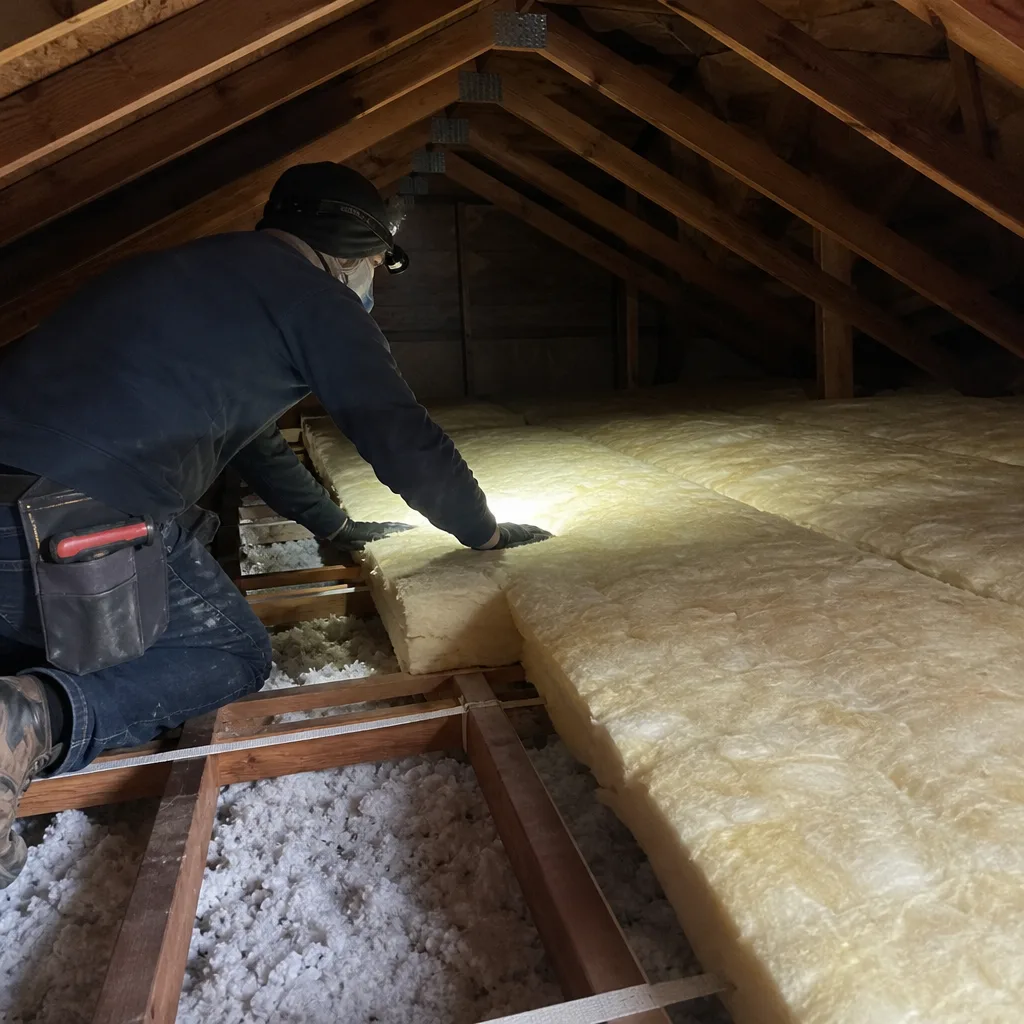
GreenFiber radiant barrier is a foil-faced product that gets stapled to the underside of roof rafters before or after blown-in cellulose goes in. It works as a system with GreenFiber’s cellulose insulation, not as a standalone upgrade, so compatibility comes down to rafter spacing and attic access rather than an insulation “model number” the way you’d match a furnace filter. The two most common configurations we see in Woodland Hills are 16-inch and 24-inch on-center rafter bays, and the barrier comes in rolls cut for each spacing. If you have an older ranch-style home near Warner Center or a Spanish-style build in the hills south of Ventura Boulevard, you may also have non-standard rafter spacing. We measure every bay before quoting, because a roll cut for 24 inches does not stretch across a 26-inch gap, and a poorly stapled edge is the first place the foil starts to tear and pull loose. We install it as part of a complete GreenFiber attic system, and we also stock Reflectix radiant barrier for homes that need a non-perforated, double-bubble option where condensation control matters more than breathability. Thistledown is an independent insulation contractor, not affiliated with GreenFiber, which means we carry both the OEM-finished product and quality aftermarket equivalents, and we’ll tell you plainly which one makes sense for your attic and which one doesn’t.
Signs Your GreenFiber Radiant Barrier Installation Is Failing
- Staples pulling loose along the rafter edges. This is the number one failure in Woodland Hills attics. Summer attic temperatures regularly hit 140 to 160 degrees in our area, and that heat cycle causes the foil to expand and contract. Cheap staples or under-driven staples back out first, and once a corner droops, the weight of the sag pulls neighboring staples in sequence.
- Torn or ripped sections near the attic access hatch. Every trip into the attic for storage, HVAC service, or pest inspection risks snagging the barrier. A six-inch tear doesn’t stay six inches for long; air movement from ridge and soffit vents catches the loose edge and peels it further.
- Dust film on the foil surface. A fine gray or brown coating on the underside of the barrier means the foil’s reflective surface is no longer rejecting heat effectively. In Woodland Hills, where we get months of dry heat and drifting dust, a barrier installed five or more years ago often has enough surface dust to cut its reflectivity meaningfully.
- Uneven room temperatures in upper-floor rooms. When the barrier fails over just part of the attic, the rooms below that section warm up first. You’ll notice a bedroom over the garage running six to eight degrees warmer than a bedroom over the living room, same AC settings, same time of day.
- Cellulose settling faster than expected beneath the barrier. A properly installed barrier changes attic airflow patterns. When it tears and starts flapping, it disturbs the air layer above the blown-in GreenFiber, and that turbulence accelerates settling. If your cellulose depth looks lower under the damaged section than elsewhere, the barrier failure isn’t cosmetic.
Replacement Cost & What’s Included
In Woodland Hills, we quote radiant barrier removal and reinstallation by the square foot of attic floor or roof surface, whichever measurement better captures the actual work. A straightforward re-staple of an existing barrier where the foil is intact runs $0.75 to $1.25 per square foot. Full replacement with new GreenFiber-compatible radiant barrier, including tearing out the old material and hauling it off, lands between $1.75 and $3.25 per square foot. The spread comes down to three things: rafter spacing consistency, attic height and walkability, and whether existing GreenFiber cellulose needs to be temporarily moved to reach lower staples. Every quote we write includes the barrier material, all staples and fasteners, drop cloths through the hallway and under the attic hatch, full debris removal, and a photo of the finished attic before we leave. There is no separate trip charge and no “material surcharge” line item that shows up after the fact. Neil Barron writes the number down before any work starts, and that is the number on the invoice.
DIY or Call Us?
There is work an owner can safely check, and there is work that goes wrong fast in a hot attic. You can safely measure rafter spacing with a tape measure, inspect the foil for tears and staple loss with a flashlight, and take photos of what you find. You should not climb into a Woodland Hills attic in July or August to re-staple barrier by hand. Attic temperatures in our area routinely exceed 140 degrees in summer, which is hot enough to cause heat exhaustion in under 30 minutes, and working overhead with a staple gun on uneven attic flooring while balancing between joists is how falls happen. We do this work in the early morning hours before the attic heats up, with two crew members and proper ventilation. If you want to see the condition of your existing barrier first, call us at (559) 245-9223 and we’ll come do an attic inspection at no charge. You’ll know exactly what is up there, what needs replacing, and what the written price is before you decide anything.
FAQs
A properly installed GreenFiber-compatible radiant barrier in Woodland Hills should last 15 to 20 years before the foil degrades enough to matter, though staple retention and physical tears are more common long-term failure points than the foil itself. Our dry climate actually helps here; barriers in humid regions corrode faster, while ours tend to fail from mechanical wear and heat cycling rather than material breakdown. Call (559) 245-9223 if you want us to look at yours and give you an honest remaining-life read.
Small tears under six inches can often be repaired with foil tape and additional staples, and we keep repair tape on every truck for exactly that purpose. Larger tears, peeling across a full rafter bay, or widespread staple failure usually make replacement the cheaper option once you account for the labor hours involved in piecemeal repairs. We’ll show you both numbers and tell you which one we’d pick if it were our own attic.
A standard single-story Woodland Hills attic takes one day for removal and reinstallation, with two technicians on site from early morning through afternoon. Larger homes, steep roof pitches, or attics where existing GreenFiber cellulose needs to be shifted to reach fastening points can run a second day.
Yes. We keep rolls sized for 16-inch and 24-inch rafter bays plus foil tape and staples on every truck. If we find damaged barrier during an insulation call, we are usually able to address it the same visit rather than scheduling a return trip.
If your attic barrier has seen better days, or if you just want to know what’s actually up there before another Woodland Hills summer hits, call Thistledown Insulation Woodland Hills at (559) 245-9223. A live person answers, every time, and the estimate is free. Know what goes in before the first board comes down.
Written by Neil Barron, Owner, Thistledown Insulation Woodland Hills at Thistledown Insulation Woodland Hills, serving Woodland Hills and nearby areas.