
GreenFiber Crawl Space Encapsulation: The Woodland Hills Owner’s Guide
We stock and install GreenFiber-compatible crawl space encapsulation for homes throughout Woodland Hills, with typical installed jobs running between $1,800 and $4,600 depending on square footage, access, and how much of the existing liner has failed. Most encapsulation replacements in this area are completed in a single day, and we keep the most common GreenFiber liner gauges and seam supplies on our trucks so we do not have to schedule a second visit. The way owners usually discover a problem is not dramatic. They smell it first. A musty note near the hallway floor register, or a child’s room that always feels damp in August even with the air running. Then they look under the house and find the liner sagging, torn at a seam, or pulled away from the foundation wall.
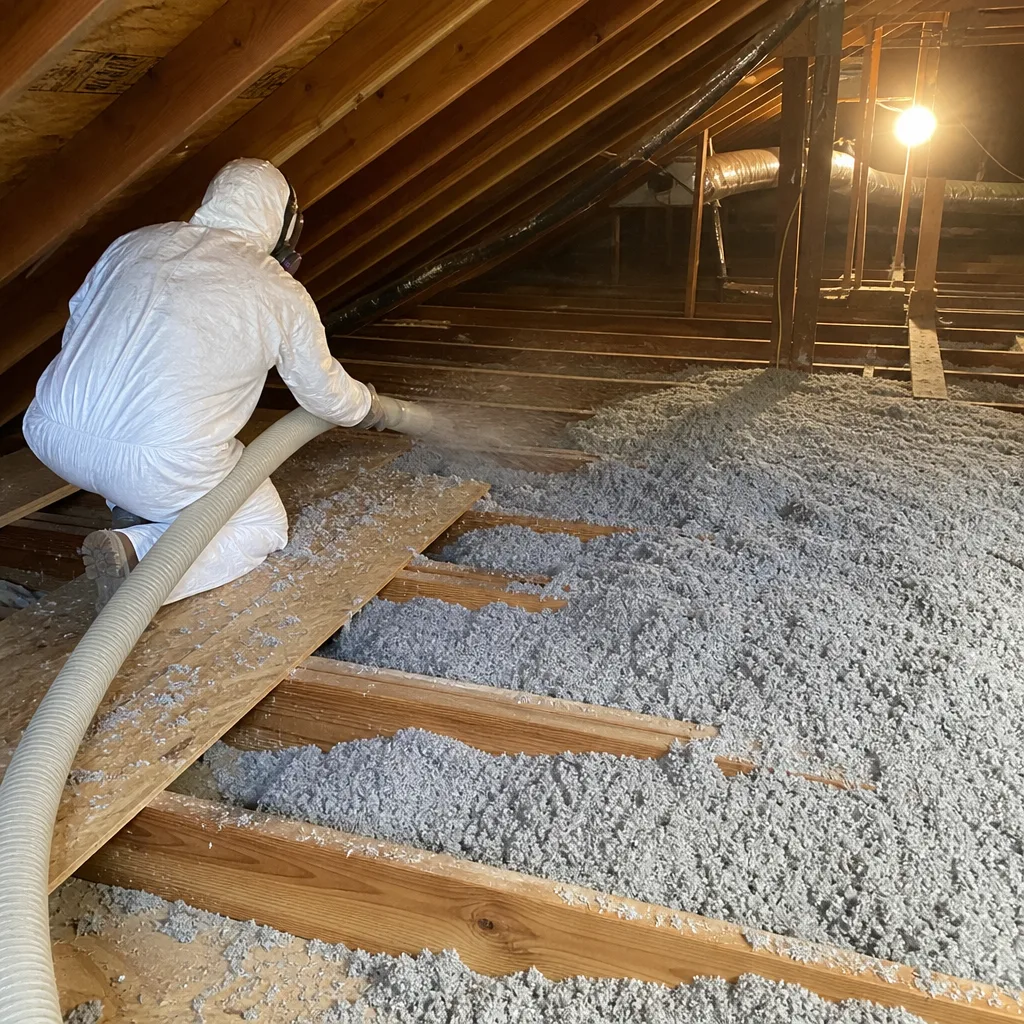
If that describes what you are dealing with, you are in the right place. And if you want a written price before anyone crawls under your house, call (559) 245-9223. We will answer live.
Which GreenFiber Models This Applies To
GreenFiber does not manufacture a single encapsulation system under one model number. What they make, and what we install with it, breaks into three compatible product lines that appear most often under Woodland Hills homes: the GreenFiber Insulation Blanket (sold in rolls of R-11 and R-19, typically paired with a reinforced poly liner), the GreenFiber Cellulose Insulation applied over a secured vapor barrier in vented crawl spaces, and the GreenFiber Air-Blown Fiber used in conditioned crawl space retrofits where the liner becomes part of the building envelope. The part that fails most often is not the GreenFiber insulation itself. It is the vapor barrier or the seam tape that holds the barrier to the piers and walls.
Here is the compatibility gotcha that trips up a lot of Woodland Hills homeowners who try to order parts direct: GreenFiber’s reinforced poly liner is specified in 6-mil, 10-mil, and 12-mil thicknesses, and the 10-mil and 12-mil rolls require 6-inch seam tape rated for polyethylene-to-concrete adhesion, not the standard 3-inch tape sold at big-box stores. If you use the wrong width or the wrong adhesive class, the seams peel within the first thermal cycle. We stock the correct 6-inch tape and all three liner gauges on our trucks. For most homes in the flatlands south of Ventura Boulevard, 10-mil is the right call. For older pier-and-beam homes off Mulholland with rocky soil and drainage quirks, we move to 12-mil.
On the OEM-versus-aftermarket question: GreenFiber’s liner and tape are good products, but they are not meaningfully different from quality aftermarket equivalents from Reflectix and other suppliers we carry. We do not upsell anyone into a brand name on polyethylene. We match the gauge, the UV rating, and the adhesive spec to your specific floor assembly. What matters is the install: the liner must run up the foundation wall at least 6 inches, get mechanically fastened with furring strips or termination bar, and be seam-sealed with the correct tape under the right surface conditions. That is what keeps a crawl space dry for 15 years versus 4.
Signs Your GreenFiber Crawl Space Encapsulation Is Failing
- Damp smell in rooms above the crawl space. This is the most common first sign. When the liner tears or a seam opens, moisture migrates up through the floor assembly. In a Woodland Hills summer, that damp air hits cold ducting and condenses, which is why you often smell it more when the AC runs.
- Sagging or pooling liner in low areas. If water has gotten under the liner, it creates low pockets where the liner dips and holds water. That water becomes a mosquito and mold habitat. A properly installed liner should lie flat and taught across the soil.
- Insulation hanging or falling between joists. GreenFiber batts and blankets are friction-fit or secured with support rods. When the barrier fails and humidity spikes, the batts absorb moisture, lose rigidity, and start to drop. Falling insulation is a symptom of a moisture problem, not the root cause.
- Higher indoor humidity or musty-smelling air from floor registers. A failing encapsulation system lets ground moisture load the indoor air. If your indoor humidity runs above 60% on a hygrometer even when the AC is cooling, the crawl space is usually the source.
- Visible tears, pulled-away seams, or pest entry points at the perimeter. Rodents chew through poly to reach the soil, and in the hillside neighborhoods around Woodland Hills we regularly see rat traffic near the foundation wall. Every tear is a moisture path, and every pulled seam is a spot where ground humidity enters the crawl space unchecked.
Replacement Cost & What’s Included
For a typical Woodland Hills home with a 900 to 1,600 square foot crawl space, a full GreenFiber-compatible encapsulation replacement runs $1,800 to $4,600 installed. The range comes down to a few variables: whether we are removing failed liner and hauling it away, how much of the existing GreenFiber insulation can be salvaged versus replaced, crawl space access height, and whether the home needs 10-mil or 12-mil liner. Homes in the hills off Topanga with irregular pier spacing and tight access run toward the top of that range. Flat, open crawl spaces in the tract developments near Warner Center run toward the bottom.
Every quote includes the liner material, the correct seam tape matched to the liner gauge, mechanical fasteners, labor, cleanup, and our 365-Day Done Right Promise. If a seam fails or the liner pulls away within the first year, we come back and make it right. No debate, no fine print. You will have your exact written number before we remove a single staple. Call (559) 245-9223 and we will walk you through the line items.
DIY or Call Us?
Crawl space encapsulation is not inherently dangerous like garage door springs or electrical work, but it is physically demanding and easy to do wrong in ways that do not show up for months. A homeowner can safely check visible liner condition, measure the crawl space dimensions, and look for standing water or pest entry points from the access hatch. What we would not recommend is a DIY removal of failed liner in a tight or wet crawl space, especially one with exposed wiring, low clearance, or evidence of rodents. Hantavirus risk from rodent droppings is real in Southern California, and disturbing old liner in an enclosed space without a respirator is not worth saving a few hundred dollars.
What we see most often after a DIY attempt is a liner that looks fine from the hatch but has loose seams at the far perimeter, gaps around the piers, or tape that peeled because the concrete was dusty when it was applied. Those failures show up as the same musty smell the homeowner thought they fixed. If you are unsure whether your crawl space is a candidate for refresh or full replacement, call (559) 245-9223 and we will give you an honest read. No obligation.
FAQs
A properly installed GreenFiber-compatible encapsulation system with 10-mil or 12-mil reinforced liner lasts 15 to 20 years in Woodland Hills, though seam tape may need spot repair around year 8 or 10 depending on soil moisture and pest pressure. Homes in the canyon-adjacent neighborhoods with higher water tables tend to see seam wear sooner than flatland homes south of the Boulevard. Call (559) 245-9223 and we can tell you what condition your liner is in after a quick inspection.
Yes, if the damage is limited to a defined tear or a short seam separation, we can patch it using compatible polyethylene patches and the correct 6-inch seam tape, and that typically costs $350 to $700 in Woodland Hills depending on crawl space access. If the liner is brittle, sagging in multiple areas, or has pest damage throughout, patching becomes a temporary fix and replacement is the better value. Call (559) 245-9223 and we will tell you honestly which route makes sense for your crawl space.
Most GreenFiber-compatible encapsulation replacements in Woodland Hills are completed in one day, typically 6 to 9 hours for a standard 1,200 square foot crawl space. Larger homes, failed insulation removal, or tight access can push the job into a second morning. You will know the timeline before we start, in writing.
We stock the GreenFiber-compatible liner gauges, seam tapes, fasteners, and insulation products on our trucks for the common Woodland Hills home sizes, so we do not send you to a distributor or make you wait on a special order. We also carry Reflectix and other barrier products where a different material is actually the better match for your crawl space. Call (559) 245-9223 and we will confirm what we have for your specific floor assembly.
If your GreenFiber crawl space encapsulation has failed or is showing early signs of it, the next step is a straight answer. Neil Barron and the Thistledown Insulation Woodland Hills crew will come out, look at the liner, the seams, the insulation, and the moisture sources, and then sit down with you and walk through exactly what goes where and what the written number covers. As Neil puts it: Know what goes in before the first board comes down. Call (559) 245-9223 for a free estimate, any day, any hour. A live person answers.
Written by Neil Barron, Owner, Thistledown Insulation Woodland Hills at Thistledown Insulation Woodland Hills, serving Woodland Hills and nearby areas.