
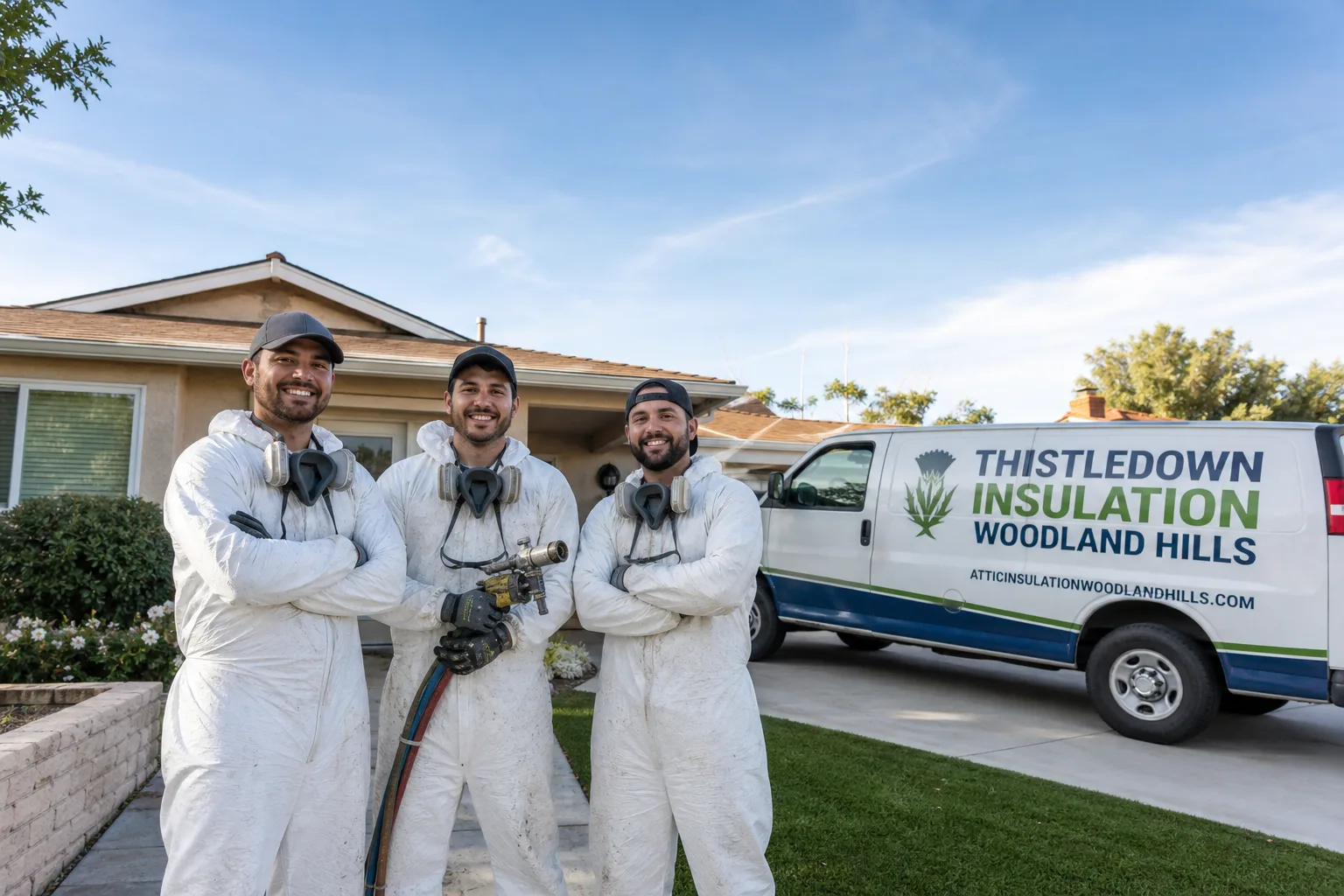
Fast, Reliable Spray Foam Insulation Across Van Nuys
Spray foam insulation in Van Nuys typically costs $2,800 – $9,400 depending on whether you’re foaming a rim joist, an attic roofline, or the full 2×4 wall cavities of a 1950s ranch. We respond to Van Nuys service calls within one business day, and every job starts with a written price before any work begins. If you own one of the thousands of original stucco ranch homes between Victory Boulevard and Roscoe, you already know the drill: summer heat pours through uninsulated walls, the AC never cycles off, and the attic feels like a kiln by noon. Call (559) 245-9223 and we’ll walk you through exactly what closed-cell or open-cell foam can do for your specific roofline, wall assembly, and budget.
Why Thistledown Insulation Woodland Hills Is Van Nuys’s Preferred Spray Foam Insulation Company
Most Van Nuys homes were built between 1948 and 1965, which means we’re rarely the first crew to open the attic hatch. We know what’s waiting up there: settled rock wool, blown-in dust, maybe old knob-and-tube wiring, and often signs of rodents in the eaves. Our technicians are background-checked and uniformed, so you know exactly who’s walking through your front door while the kids are doing homework. We lay drop cloths across your hallway, wear shoe covers from the front door to the attic hatch, and we ask before we move or touch anything. That’s the Cedarwell Care Promise, and it’s not an add-on; it’s the standard on every Van Nuys job.
When you call, a live person answers. Always. Not a voicemail tree, not a next-business-day callback. If you call at 11 p.m. with a question about whether your roofline can take closed-cell foam, someone picks up. That matters in Van Nuys, where a week of 100°F heat turns an under-insulated attic into an emergency. We also stand behind every install with a 365-Day Done Right Promise: if it’s not done right, we make it right. No debate, no fine print. Written price before any work starts, every single time. That’s the Thistledown standard, set by Neil Barron and held across every job we run in Van Nuys.
Closed Cell Spray Foam Insulation in Van Nuys
Closed Cell Spray Foam Insulation is the workhorse for Van Nuys’s flat and low-slope roof ranch homes, where adding conventional batt insulation often isn’t code-compliant without a full roof tear-off. Closed-cell foam acts as an air barrier, vapor retarder, and structural adhesive all at once, and at roughly R-6.5 per inch, it packs meaningful R-value into a 2×4 wall cavity that was never designed to hold much insulation. In Van Nuys, a full roofline job with closed-cell foam typically runs $6,400 – $11,800 depending on square footage and access. Rim joist and garage ceiling applications tend to fall in the $1,800 – $4,200 range.
Unlike nearby San Fernando Valley cities with newer construction or higher-density housing, Van Nuys has thousands of original 1950s stucco ranch homes with unvented, flat low-slope roof assemblies where closed-cell spray foam is often the only practical way to add R-value without tearing off the roof. We see this block by block north of Sherman Way and east of Sepulveda. Those houses were built with plywood or skip sheathing over 2×6 rafters, no soffit vents, and often no ridge vent. Closed-cell foam sprayed directly to the underside of the roof deck creates a conditioned attic: the roof surface becomes the thermal boundary, and the attic stays within a few degrees of the living space.
When Van Nuys Roof Decks Need Closed-Cell
If your home has a flat or low-slope roof with no attic ventilation, closed-cell foam is the straightforward answer. It seals the roof deck, blocks radiant heat gain before it reaches the living space, and eliminates the stack effect that pulls hot air into the house during summer afternoons. We’ve done this on dozens of Van Nuys Boulevard – area ranch homes where the original rock wool had settled to R-8 or less and the ceiling felt hot to the touch by 2 p.m.
Wall Cavity Retrofit for 2×4 Construction
Van Nuys’s original 2×4 exterior walls were built for a different era. Closed-cell foam injected into those shallow cavities gives you R-13 to R-15 and, just as important, seals the wall assembly against air infiltration. That’s the difference between a house that leaks cool air through every outlet plate and one that holds temperature through a heat wave. We handle the prep carefully: old wiring gets inspected before foam, and every cavity is sealed so the foam cures properly.
Open Cell Spray Foam in Van Nuys
Open Cell Spray Foam is the quieter, softer-spring option for Van Nuys attics and interior walls, where dense closed-cell isn’t always necessary. At roughly R-3.7 per inch, open-cell foam expands to fill gaps and cracks completely, creating an air seal that fiberglass batts simply can’t match. In Van Nuys, a full attic floor or roofline open-cell spray typically runs $3,200 – $7,600 depending on square footage. Interior wall and band joist applications generally land in the $1,200 – $2,900 range.
For homes where the roof actually has working soffit and ridge vents, open-cell foam on the attic floor is often the better value than closed-cell on the roofline. It air-seals the living space below, reduces dust migration from the attic, and makes the house noticeably quieter. We install open-cell products from Icynene and Demilec, chosen because they cure soft enough to accommodate the natural movement of a 1950s wood frame through Van Nuys’s temperature swings from July to January.
Attic Floor Air Sealing
Many Van Nuys homeowners don’t need to foam the roofline at all. They need the attic floor sealed so the cool air stops escaping through every can light, ceiling crack, and top plate. Open-cell foam handles that cleanly, and it’s the right product for the job when attic ventilation stays intact.
When Not to Use Open-Cell on a Roof Deck
One thing we flag on every Van Nuys flat-roof inspection: open-cell foam on the underside of a low-slope roof deck is a bad idea. Van Nuys gets rare but heavy winter rain events, and open-cell’s vapor permeability means any moisture that works its way through the roof assembly can linger against the plywood. That leads to premature rot. We’ll say it plainly: on a flat or low-slope roof, closed-cell is the right call. We won’t sell you the wrong product just because it’s cheaper up front.
Trusted Brands We Service in Van Nuys
We install and service spray foam from a focused set of manufacturers chosen for how their products perform in San Fernando Valley heat, including Icynene, Demilec, and Spray Foam Insulation systems designed for unvented assemblies. We also work with Owens Corning and Johns Manville products when a hybrid approach, foam plus batt, fits the job. That matters because we can match the exact foam chemistry to your roofline and wall assembly rather than forcing whatever’s on the truck. For Van Nuys jobs, we stock the common foam kits and accessories locally, which means faster turnaround when you need a rim joist sealed before the next heat wave. Van Nuys homeowners get straight answers about which product fits, not a brand pitch.
Common Spray Foam Insulation Problems We See in Van Nuys Homes
- Settled rock wool in original attics: Van Nuys homes built in the 1950s and early 1960s often have original rock wool batts that have compacted to R-8 or worse. When we pull back the old insulation, the heat gain through the drywall below is obvious; the space feels like an oven by late afternoon.
- Unvented flat-roof assemblies: The low-slope, unvented roof construction common on Van Nuys ranches creates a scenario where conditioned air leaks straight out of the living space and hot air pushes in. Closed-cell foam on the roof deck is frequently the only retrofit that works without a tear-off.
- The “Van Nuys Special” attic: Dusty, compacted batts with rodent droppings and old, brittle electrical wiring that needs attention before any new insulation goes in. We’ve pulled enough of these to know that skipping the rodent abatement and wiring check only seals the problem behind new foam, forcing a later tear-out.
- Knee walls and half-story heat bleed: Ranch additions from the 1960s and 1970s often left open knee walls and unsealed band joists that feed hot air into the house all summer. Spray foam is the fastest way to close those thermal bypasses, and it’s usually a one-day fix in Van Nuys’s larger attic spaces.
Pricing for Spray Foam Insulation in Van Nuys, CA
Here are the numbers we typically quote for Van Nuys work, so you have a realistic starting point before anyone picks up a phone. Rim joist spray foam in Van Nuys runs $1,200 – $2,900. Garage ceiling foam applications are typically $1,800 – $4,200. Open-cell attic floor or roofline work lands at $3,200 – $7,600. Closed-cell roof deck or full wall cavity projects generally run $6,400 – $11,800. Access, roof pitch, and the condition of existing insulation shift those figures, and we’ll put your exact written price in your hand before any work begins. Call (559) 245-9223 for a free estimate; you’ll get a specific number, not a vague range, and it stays the same unless the scope changes in writing.
We Also Serve Cities Near Van Nuys
Our crews work throughout the San Fernando Valley. We serve Encino, Reseda, Tarzana, and Northridge with the same written-price guarantee and 365-Day Done Right Promise that covers every Van Nuys job. If you’re in a neighboring city and wondering whether spray foam fits your home’s construction, call us and we’ll give you a straight answer over the phone.
Serving Van Nuys, CA - Our Local Coverage Area
We’re based in the Van Nuys area and know this community well. Use the map below to see our service coverage - if you’re nearby, we can almost certainly help.
FAQs About Spray Foam Insulation in Van Nuys
Yes. Closed-cell spray foam can be sprayed directly onto the underside of the roof deck from inside the attic, with no roof removal at all. This is exactly the situation Van Nuys’s original flat and low-slope ranch roofs create, and closed-cell foam is often the only code-compliant retrofit option that doesn’t require a tear-off. The foam adheres to the plywood or skip sheathing, creates a conditioned attic, and adds structural rigidity to the roof assembly. Call (559) 245-9223 and we’ll assess your specific roof construction, because some older skip-sheathing roofs need a primer pass first.
Yes. You need the old rock wool and any rodent droppings removed before foam goes in. Spraying over droppings and chewed wire insulation traps those contaminants behind cured foam, and any future electrical work means cutting through contaminated material. In Van Nuys we encounter this “Van Nuys Special” constantly, and our process includes full removal, sanitizing, and an electrical check before any foam is sprayed. It adds to the job cost, but it’s the only honest way to do it, and the 365-Day Done Right Promise doesn’t apply to a job we knowingly did wrong from the start.
Spray foam will cut most of the dust and allergen migration that enters through the attic, top plates, and unsealed wall penetrations, though it won’t fix leakage around single-pane window frames themselves. Van Nuys’s original single-pane windows are a huge air leakage source, but what foam does is seal the building envelope’s hidden paths: the attic floor, header joints, outlet boxes, and rim joists. Most homeowners notice a significant dust reduction within a week of install, simply because the house stops pulling dusty attic air into the living space every time the AC or a bathroom fan cycles on.
Closed-cell spray foam fills the full 2×4 wall cavity to R-13 plus an air seal, which is the best a 2×4 wall can hold without reframing. Open-cell foam gets you to about R-11 with an air seal. Either one transforms how the house behaves in a heat wave, because the walls stop conducting heat inward and stop leaking conditioned air outward. In Van Nuys’s 105°F spells, the difference between an uninsulated stucco wall and a foamed 2×4 cavity is often several degrees of indoor temperature and a noticeably shorter AC cycle.
No, because spraying foam on the roofline means the attic becomes an unvented, conditioned space, and the existing vents are either sealed or become irrelevant. The key is that the roof deck itself becomes the thermal boundary, so the soffit and gable vents no longer serve a purpose. However, if you’re foaming only the attic floor and leaving the roof uninsulated, then yes, existing ventilation needs to be working properly and may need to be brought up to current standards first. We’ll tell you exactly which situation applies to your Van Nuys home during the estimate.
Thistledown is the soft fluff of the thistle, one of nature’s lightest insulators. The name is a promise about how carefully we work. If you’re in Van Nuys and want a written price, a crew that wears shoe covers, and a foam system matched to your exact roofline, call (559) 245-9223 today. We’ll answer in person, walk you through the right product for your home, and leave you with a clean attic and a photo of the clean-up before we pull the van away.
Written by Neil Barron, Owner at Thistledown Insulation Woodland Hills.