
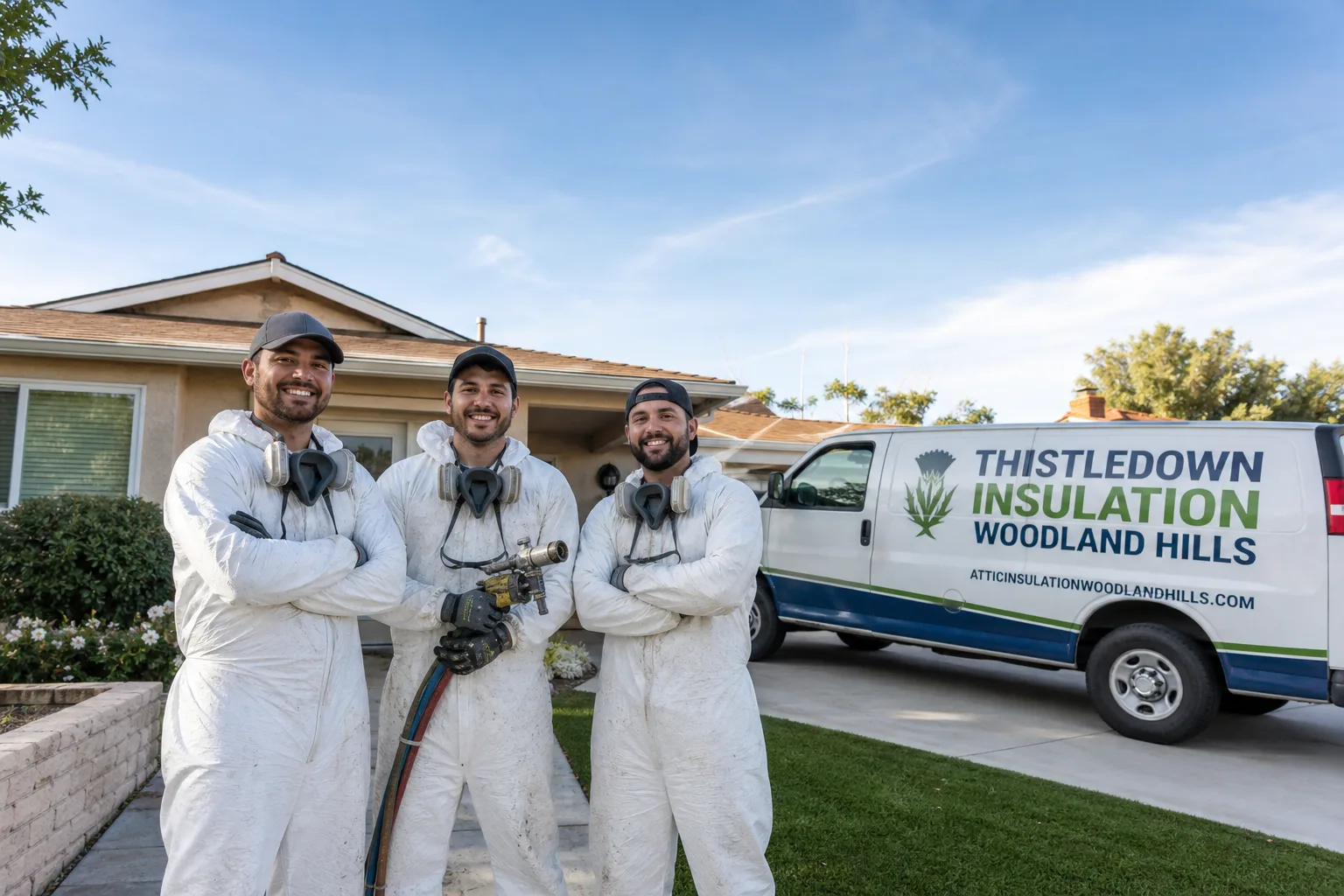
Fast, Reliable Spray Foam Insulation Across Topanga
Spray foam insulation for a Topanga canyon home usually costs between $3,200 and $9,800 depending on the surface area, foam type, and how much old insulation needs to come out first. You’ll have your exact written number before any work starts, not a range that drifts upward after the crew arrives. Topanga’s steep lots, shaded canyons, and post-and-beam construction change how spray foam should be applied, and we plan for that before the first hose comes off the truck. If you’re tired of condensation on exposed beams or a crawl space that pulls cold air up through the floor, call (559) 245-9223 for a free estimate.
Why Thistledown Insulation Woodland Hills Is Topanga’s Choice for Spray Foam
Topanga homeowners call us because our crews understand what happens when spray foam meets a shaded canyon wall at night. The temperature swing between a 95-degree afternoon and a 55-degree canyon evening creates condensation on uninsulated roof decking, and a generic foam application can make that problem worse if the detailing isn’t right. We’ve worked on rustic cabins off Old Topanga Canyon Road, mid-century homes near Fernwood, and custom builds along Saddle Peak Road, so we know what each construction style needs.
Every Spray Foam Insulation job we run through Topanga is assigned to background-checked, uniformed technicians who lay drop cloths across your hallway and wear shoe covers from the front door to the attic hatch. Neil Barron, who leads our team, holds the crew to the Cedarwell Care Promise on every visit: ask before moving anything, respect quiet hours, and explain the price before the work. If a detail isn’t right after we finish, the 365-Day Done Right Promise means we come back and make it right. No debate, no fine print.
When a Topanga homeowner calls, a live person answers. Not a voicemail tree. If you’re trying to schedule around a baby’s nap or a dog that gets anxious around strangers, tell us and we’ll work the visit around your household.
Crawl Space Spray Foam Insulation in Topanga
Crawl Space Spray Foam Insulation in Topanga often means closed-cell foam applied to the underside of an elevated floor, and it addresses a problem we see constantly on canyon lots: the cold-draft chimney effect that pulls damp air up from shaded ground into post-and-beam framing. Homes built on stilts or piers above sloping ground lose heat through the floor in winter and absorb moisture through exposed joists year-round. A typical crawl space spray foam job in Topanga runs $1,800 to $4,600 for a standard footprint, though larger or harder-to-access spaces under steep lots can reach $7,000.
When elevated floors need closed-cell over open-cell
In a vented crawl space near Topanga Creek or any seasonal drainage, open-cell foam acts like a sponge against damp winter ground air. It wicks moisture, loses R-value, and can hold water against Douglas fir floor framing. Closed-cell foam resists that moisture and adds structural rigidity, which matters on older post-and-beam floors already carrying decades of canyon humidity.
What the crew does before spraying
We check for signs of condensation on joists, look at how the crawl space vents sit relative to prevailing canyon wind, and confirm whether any existing fiberglass batts are holding moisture. Then we lay drop cloths from the access point to the work area and photograph the clean-up before we leave. You’ll see the photo before the van pulls away.
Garage Spray Foam Insulation in Topanga
Garage Spray Foam Insulation in Topanga typically covers one of two situations: a garage that shares a wall with living space and leaks air into the house, or a garage used as a workshop, studio, or music room that needs to hold temperature. Most garages on Topanga’s rustic and mid-century lots were never insulated to modern standards. A garage ceiling or shared-wall spray foam application in Topanga generally runs $1,400 to $3,800, depending on whether you want the ceiling, the walls, or both done.
Shared walls and attached garages
When a garage shares a wall with a bedroom or kitchen, that wall often has nothing between the studs. Spray foam seals it and stops the exhaust smell, heat, or cold from bleeding through. We’ve done this on Fernwood Pacific homes where the garage sits directly under a bedroom and the floor stayed cold all winter.
Detached garages used as studios
Many Topanga residents use detached garages as recording studios, art spaces, or home offices. Spray foam on the roof deck and walls keeps the space usable through December and July without running a space heater or window AC constantly. For detached structures, we also address the gap under the garage door and any gaps at the roofline where canyon wind pushes air through.
What Makes a Post-and-Beam Topanga Home Different
Here’s the thing that only applies to Topanga, and it’s why generic spray foam advice from a Valley insulation page won’t serve you. In shaded canyon microclimates, uninsulated cathedral ceilings with exposed post-and-beam details create condensation risks that flat-ceiling homes in Woodland Hills rarely see. A hot, dry afternoon heats the roof deck. Then the coastal-influenced evening air drops the temperature fast, and the underside of that roof deck hits the dew point. Moisture forms on beams, drips onto drywall or floorboards, and feeds decay in old-growth Douglas fir. Spray foam can fix this, but only when paired with vapor-retarder detailing at the ridge and careful attention to how the foam meets each beam. Spray foam directly against roof decking without that detailing can trap moisture behind the framing and make the decay worse. We’ve seen this failure after other crews sprayed and left. It’s slow, quiet, and expensive to repair.
Our crew retrofitted a mid-century post-and-beam home off Saddle Peak Road where open-cell spray foam in the cathedral ceiling was paired with a vapor-retarder detailing at the ridge. We also treated the elevated crawl space with closed-cell foam to stop the cold-draft chimney effect that was pulling moisture into the Douglas fir beams every winter. That job required coordination around the homeowner’s two dogs, a narrow switchback driveway, and a roof pitch that made our crew’s rope work essential. We plan for all of it.
Spray Foam and Topanga’s Fire Reality
Topanga’s Santa Ana winds are a fact of life, and wind-driven embers don’t need direct flame to start a fire. They need a gap: a vent, an eave opening, a gap where roof decking meets a beam. Closed-cell spray foam seals many of those gaps and slows the path embers take into an attic or cathedral ceiling cavity. It isn’t a fireproofing product, and no insulation product alone makes a home fireproof. But air-sealing the underside of the roof deck and any exposed openings reduces the places where embers can enter and smolder. For Topanga homeowners in the wildland-urban interface, that matters. We also mention this because Topanga buyers and sellers now ask about it during inspections, and you should know what spray foam does and doesn’t do before you spend the money.
Trusted Brands We Service in Topanga
Thistledown installs products from Owens Corning, Johns Manville, Knauf, GreenFiber, Rockwool, CertainTeed, Icynene, and Demilec. That lineup matters when the right product depends on the situation: an off-grid home with no mechanical ventilation needs different attention than a 1970s A-frame with exposed rafters. We match the product to the house, not the other way around. Because crews serve Topanga regularly, we keep project material staged for canyon jobs and don’t make you wait through a long supply-chain delay for closed-cell foam or vapor-retarder materials. If you want a specific brand or a pet-safe option, ask and we’ll tell you exactly what we’re putting in your ceiling and why.
Common Spray Foam Insulation Problems We See in Topanga Homes
- Condensation on cathedral ceiling beams. Shaded canyons cool fast at night, and uninsulated roof decking drops below the dew point. Moisture collects on exposed beams and leads to slow wood decay you won’t see until it’s serious.
- Wicking in elevated crawl spaces. Open-cell foam in a vented, elevated crawl space absorbs moisture from damp winter ground and holds it against floor framing. R-value drops and mold follows on post-and-beam supports.
- Over-sealed off-grid homes. In a home with limited mechanical ventilation, sealing every gap with spray foam without adding a controlled ventilation path creates indoor humidity spikes during Santa Ana heat waves. It feels sticky, and it isn’t healthy.
- Gaps around roof penetrations. Older Topanga cabins often have stove pipes, skylights, and vent pipes cut through cathedral ceilings. If those penetrations aren’t sealed at the roof deck, spray foam on adjacent surfaces won’t stop air movement around them.
Pricing for Spray Foam Insulation in Topanga, CA
Here’s what Topanga homeowners can expect to pay, based on the jobs we’ve done in the canyon over the years. Open-cell spray foam on a cathedral ceiling typically runs $2,800 to $6,500 depending on square footage and access. Closed-cell spray foam for a crawl space or rim joist application generally lands between $1,800 and $5,200. A garage ceiling or shared-wall job runs $1,400 to $3,800. Roof deck spray foam on an A-frame or post-and-beam home usually falls between $4,500 and $9,800 because of the detailing, scaffolding or rope work, and the need to protect exposed beams. Every customer gets a written price before any work begins, and the number on that page is what you pay. Call (559) 245-9223 to schedule a free estimate, and we’ll measure everything and write the number down.
We Also Serve Cities Near Topanga
Our crews serve Spray Foam Insulation in Topanga plus Woodland Hills, Calabasas, Tarzana, and Pacific Palisades. If you’re on the edge of Topanga near the Woodland Hills side or managing a property in Calabasas with canyon exposure, we can often schedule a visit during the same week as your Topanga estimate. Dispatch and scheduling are coordinated from the brand’s Los Angeles office, with crews serving Topanga locally.
Serving Topanga, CA - Our Local Coverage Area
We’re based in the Topanga area and know this community well. Use the map below to see our service coverage - if you’re nearby, we can almost certainly help.
FAQs About Spray Foam Insulation in Topanga
Spray foam prevents condensation by keeping the underside of the roof deck warmer than the dew point, so moisture can’t form on the decking or the beams it touches. But this only works in Topanga when the foam is paired with vapor-retarder detailing at the ridge and around each beam intersection; without that, the foam can trap moisture behind the framing. Call us at (559) 245-9223 and we can look at your ceiling and tell you what’s actually happening.
Yes, it can, if the home is sealed without adding a controlled ventilation path. In off-grid Topanga homes that rely on passive airflow or a wood stove, over-sealing with spray foam can trap humidity and combustion byproducts indoors. We assess the home’s ventilation before we spray and recommend where a small controlled vent or ERV placement needs to be considered, so the home stays tight without going stale.
Yes, using closed-cell spray foam. Closed-cell foam doesn’t absorb moisture the way open-cell does, so it’s the right product for elevated, vented crawl spaces near Topanga Creek or any seasonal drainage where ground moisture is high. We also check the existing vapor barrier and vent configuration before spraying, because sealing the underside of a floor changes how the crawl space breathes. Estimates are free, so call (559) 245-9223 and we’ll assess your specific crawl space.
Closed-cell spray foam air-seals gaps at eaves, roof decking joints, and penetrations where wind-driven embers can enter and smolder. It’s not a fireproofing product and won’t stop direct flame, but it closes the small entry points that embers exploit. For Topanga homes in the wildland-urban interface, that’s a meaningful reduction in the paths fire can take into an attic or cathedral ceiling cavity.
Yes, spray foam can be installed between the rafters and then covered with drywall, wood paneling, or another finish that matches your A-frame’s aesthetic. The foam itself is exposed only during the installation, and the finish layer hides it completely. On exposed-rafter A-frames in Topanga, we also address the ridge connection so condensation doesn’t form where the two roof planes meet. Call (559) 245-9223 for an exact quote and we’ll explain what your specific A-frame needs.
Written by Neil Barron, Owner at Thistledown Insulation Woodland Hills, serving Topanga and surrounding canyon communities with spray foam and attic insulation since 2003.