
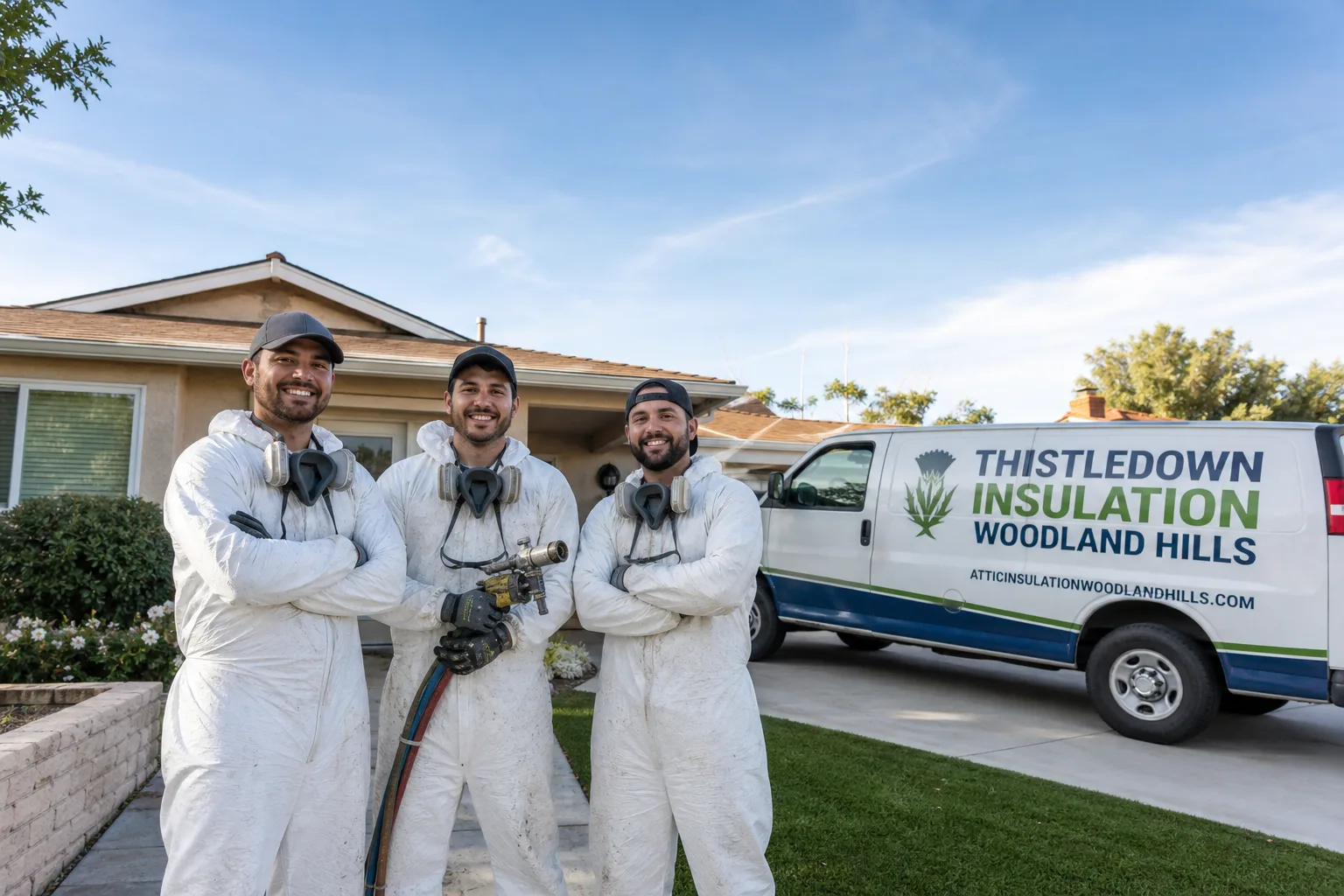
How Much Does Insulation Removal & Replacement Cost in Woodland Hills?
Insulation removal and replacement in Woodland Hills typically runs between $2,100 and $6,800 for a standard 1,200 to 1,800 square foot attic, with most homeowners paying right around $3,900. The final number depends mostly on your attic’s square footage, the type of old insulation being pulled out, and whether you’re upgrading to fiberglass batts, blown-in cellulose, or closed-cell spray foam. You’ll have your exact written price before any work begins, so there’s no guesswork on the invoice when the job is done.
Insulation Removal & Replacement Cost Breakdown (2026)
Here’s what we’re seeing across the Woodland Hills market right now. These are real ranges we quote from, not national averages pulled from a database. The Warner Center corridor, Walnut Acres, and the hillside homes south of Ventura Boulevard all have slightly different labor dynamics because of attic access and roof pitch, but the numbers below hold up across the zip codes here.
| Line Item | Typical Range (Woodland Hills) | What You’re Paying For |
|---|---|---|
| Old insulation removal (fiberglass batts) | $0.60 – $1.20 per sq ft | Safe extraction, bagging, and disposal of fiberglass rolls or batts |
| Old insulation removal (blown-in cellulose or fiberglass) | $0.90 – $1.80 per sq ft | Commercial vacuum / HEPA extraction, containment, and cleanup |
| Old insulation removal (rodent-contaminated or water-damaged) | $1.50 – $2.75 per sq ft | More handling care, sanitation, and sometimes double-bagging for disposal |
| Air sealing (attic floor penetrations, top plates, can lights) | $450 – $1,100 total | Foam or caulk sealing around wiring, plumbing vents, and recessed lights |
| New insulation: fiberglass batt (R-30 to R-38) | $1.00 – $2.10 per sq ft | Owens Corning or Johns Manville batts, installed to density |
| New insulation: blown-in cellulose (R-38) | $1.20 – $2.40 per sq ft | GreenFiber or similar, blown to depth with baffles in place |
| New insulation: blown-in fiberglass (R-38) | $1.30 – $2.60 per sq ft | Knauf or CertainTeed loose-fill fiberglass |
| New insulation: closed-cell spray foam (R-21 to R-28) | $3.50 – $6.50 per sq ft | Icynene or Demilec, including prep and clean over-spray control |
| Attic hatch / access insulation + seal | $80 – $250 | Weatherstripping and an insulated hatch cover |
| Soffit baffles / vent chutes (per piece, installed) | $12 – $25 each | Keeping air moving from eaves to ridge vent |
Most Woodland Hills homes with a 1,400 square foot attic fall into the $2,800 to $4,600 range for a full removal and replacement using blown-in cellulose or fiberglass. A same footprint with closed-cell spray foam is more likely to land between $5,200 and $8,100. The spread isn’t because contractors are vague; it’s because two attics with identical square footage can have completely different access points, joist spacing, and ductwork in the way.
What drives the price up
Low-slope roofs with tight clearances near the eaves, recessed lighting that requires boxing before insulation goes near it, and attics with old knob-and-tube wiring all push labor hours up. In the hillside neighborhoods south of the Boulevard, we also see more attics with tight scuttle holes and sloped access, which means more hand work and less room for equipment. Rodent activity or water staining from ridge vents adds sanitation time and disposal costs, and will always be reflected in the written price before we begin.
What drives the price down
A clean, dry attic with full-height access, open framing, and no lighting or wiring complications is the fastest job. If the old insulation is loose-fill that hasn’t been compressed or contaminated, removal goes quickly with a commercial vacuum. And if your attic already has functional soffit baffles, you won’t need to pay for vent work, which saves $150 to $400 on a typical home.
What Affects Insulation Removal & Replacement Pricing in Woodland Hills
- Attic square footage and ceiling height. Prices scale with area, but a tight attic with 3-foot headroom costs more per square foot than a full walk-up attic, simply because the crew moves slower in confined space.
- Type and condition of the old insulation. Rolled fiberglass batts come out fast. Blown-in cellulose that’s been sitting since the 1980s and has settled into a dense mat takes longer. Water damage or rodent waste adds disposal handling.
- Replacement material choice. Cellulose is the value play; fiberglass batts run the middle; closed-cell spray foam is the premium option for air sealing and structural benefit, and it costs accordingly.
- Air sealing work. Many Woodland Hills homes built in the 1960s and 1970s have never had their attic floor sealed. Doing this during replacement is the most cost-effective time, but it’s a line item of its own.
- Access and site conditions. Hillside properties with narrow driveways, shared walls, or attic hatches in closets make equipment setup slower. Homes in Walnut Acres with detached garages sometimes require a second access point or longer hose runs.
- Permit and code compliance. Woodland Hills follows Los Angeles building codes for attic insulation R-value minimums and eave ventilation. Most straightforward replacement jobs don’t need a permit, but when old wiring or venting is in play, a quick check with the building department avoids trouble later.
Why Removal Matters Before You Replace
Some companies will offer to blow new insulation right over the old stuff. In a few attics, that’s genuinely fine. In many older Woodland Hills homes, it’s a shortcut that hides problems. If the old insulation has been wet at any point, it’s lost its loft and often developed mold or mildew. If rodents have nested in it, the waste stays in the attic and the smell doesn’t leave just because fresh cellulose got dumped on top. And if your can lights were installed before current fire-safety standards, fresh insulation piled against them is a real fire risk.
Removal lets us see the full attic floor: the junction boxes, the plumbing vents, the places where warm air leaks up from the living room below. That visibility is when air sealing actually works. We’ve been doing insulation removal and replacement in Woodland Hills long enough to know that a proper extraction almost always finds something worth fixing before the new material goes in.
How we handle the mess
We lay drop cloths across your hallway and wear shoe covers from the front door to the attic hatch. The old insulation goes into sealed bags, not open buckets, and those bags go straight to the truck. When the job is done, we take a photo of the clean-up before we leave, and you’ll see that photo. If the baby is napping, we use hand tools instead of loud equipment during quiet hours. These aren’t options you pay extra for. They’re how every Thistledown job runs, because the crews work under the Cedarwell Care Promise on every visit.
How to Save on Insulation Removal & Replacement
- Combine removal, air sealing, and replacement into one visit. Doing these separately means paying for setup and cleanup twice. One mobilization, one containment plan, one cleanup. Savings of $300 to $700 are typical versus splitting the work.
- Schedule during the shoulder season. Insulation crews in Woodland Hills get slammed in July and August when attics are miserable to work in, and in December and January when the cold snaps hit. Late spring and early fall often have more scheduling flexibility, and occasionally better pricing.
- Ask about rebates before you commit. LADWP and Southern California Edison occasionally run weatherization rebate programs for attic insulation and air sealing. Eligibility changes by year, so it’s worth a 15-minute check before you finalize your material choice.
- Don’t automatically choose the cheapest quote. A low bid that skips containment, skips disposal fees, and skips air sealing isn’t a lower price, it’s a partial job. Get the whole scope written down. You’re not hunting for the lowest bid here; you’re hiring a crew that will treat the house like a home.
- Get a written price first. A real quote means no surprises when the invoice comes. Call (559) 245-9223 and we’ll walk you through the scope, the material options, and a written number before anyone picks up a tool.
Replacement Material Options and What They Cost in Woodland Hills
This matters because the material choice changes the price by thousands of dollars, and it also changes how the house feels afterward. Here’s a straight breakdown of what each option costs here and where it makes the most sense.
Fiberglass batts: the budget-friendly classic
Owens Corning and Johns Manville batts are the most common replacement in standard framed attics. At $1.00 to $2.10 per square foot installed, they’re predictable, easy to cut around framing, and they handle mild attics well. They don’t seal air gaps on their own, so pairing them with a proper air sealing pass matters. Batts are a good fit for open attics with standard joist spacing and no weird angles.
Blown-in cellulose: the value workhorse
GreenFiber blown-in cellulose runs $1.20 to $2.40 per square foot and does a better job filling odd corners and irregular cavities than batts. It’s made mostly from recycled paper treated with fire-retardant borates, and it can be blown to any R-value depth. For older Woodland Hills homes with uneven joist spacing or lots of blocked-off attic areas, cellulose covers more completely than cut-and-fit batts.
Blown-in fiberglass: the middle ground
Knauf and CertainTeed loose-fill fiberglass sits between batts and cellulose on effective coverage. It doesn’t settle as much as old-school cellulose, and it doesn’t absorb moisture the way paper-based products can. Expect $1.30 to $2.60 per square foot installed for an R-38 attic fill.
Closed-cell spray foam: the premium air barrier
Icynene and Demilec closed-cell foam runs $3.50 to $6.50 per square foot. It’s the most expensive option and the most effective at air sealing, because it’s an insulation and an air barrier in one pass. In homes with vaulted ceilings, skimpy roof deck clearance, or strong Santa Ana wind exposure, the performance difference is noticeable. Not every attic benefits enough to justify the premium, but some genuinely do.
Pet-safe product options
Where a choice exists between similar products, we choose pet-safe options so the dog can be home during the job. That means low-VOC binders and materials without fiberglass itch dust where a real alternative exists. If anyone in the house has respiratory sensitivity, mention it when you call. We’ll choose the product accordingly and tell you exactly what’s going in near the nursery or the master bedroom.
Why the Correct R-Value Matters in Woodland Hills
Woodland Hills sits in Climate Zone 3, which Los Angeles County building code treats as a hot-dry climate with cool winter nights and significant summer heat. Current attic insulation recommendations here land at R-30 to R-38 for most homes, and R-38 is what we typically recommend for homes with central air conditioning. The valley heat spreads through your ceiling plane all afternoon in August, and the right R-value slows that heat transfer down to a manageable level.
Older homes in Woodland Hills often have R-11 or R-19 in the attic, sometimes less. That’s a 1970s or 1980s-era standard, and it was undersized even then. When we remove that old material, we’re often the first people to see the top plates and wiring since the house was built. That access window is exactly why replacement matters more than a top-up: you only get one clean view of the attic floor.
Signs You Need Removal Instead of a Top-Up
- Water stains on ceiling drywall below the attic. Water getting past the roof deck means the insulation above is compromised, even if it looks dry on top.
- Musty smell in the hallway near the attic hatch. Damp cellulose or fiberglass held onto moisture, and the odor is coming from the attic, not the walls.
- Visible droppings or nesting material. Rodents in the attic contaminate insulation, and the fix is full removal plus sanitation, not adding material on top of waste.
- Your can lights are original to the house. Pre-1990s recessed fixtures weren’t designed to be buried in insulation. Old insulation touching those cans is a fire hazard, and that material should come off before upgrades.
- You can see daylight around plumbing vents or chimney chases from inside the attic. Leaks at the attic floor mean the old insulation has been moving air for years, and the fix starts with removal and air sealing.
How the Job Runs: Step by Step
This is what to expect when Thistledown Insulation Woodland Hills removes and replaces your attic insulation. It’s not vague. It’s a sequence you can plan your day around.
Step 1: The walk-through and written price
We inspect the attic, measure the square footage, check the access, look at the existing insulation depth and condition, and check for air leaks, wiring issues, and vent problems. Then you get a written price before any work starts, every single time. No ranges, no surprises on the invoice.
Step 2: Floor protection and containment
Drop cloths go down across the hallway and under the attic access. Shoe covers go on at the door, and they stay on from the front door to the attic hatch. If pets are home, we work around them and choose product accordingly.
Step 3: Removal
Commercial vacuum equipment extracts the old insulation through sealed hoses. Batts come out by hand in bags. All of it goes out through the attic access and straight to the truck, no open containers through the living space.
Step 4: Air sealing
Before any new material goes down, we seal the attic floor: top plates, plumbing vents, electrical penetrations, can light housings, and the attic hatch frame. This is the step most attic upgrades skip, and it’s the step that makes the biggest comfort difference in a Woodland Hills summer.
Step 5: New insulation install
To the R-value we agreed on, with the product you chose, blown or batts or spray foam. Depth markers go on the joists so you can see the R-value is real, not promised.
Step 6: Clean-up and photo
We clean the floors, remove the drop cloths, and take a photo of the finished clean-up before the van pulls away. You get that photo.
FAQs – Insulation Removal & Replacement Cost
How much does insulation removal cost per square foot in Woodland Hills?
Removal alone runs $0.60 to $1.80 per square foot for standard materials, with rodent-contaminated or water-damaged material pushing to $2.75 per square foot. For a 1,400 square foot attic, that’s $840 to $2,500 just for extraction. Call (559) 245-9223 for a written breakdown on your exact attic size.
Is it cheaper to remove and replace insulation or just add more on top?
Adding more on top costs less upfront, usually $1.20 to $2.60 per square foot for blown-in cellulose or fiberglass. But if the old insulation is wet, rodent-contaminated, compressed, or covering old can lights, topping up hides problems instead of fixing them. In a 1960s-era Woodland Hills home, removal and replacement is usually the more honest long-term investment, at $2.20 to $4.80 per square foot all-in for conventional materials. We’ll give you a straight answer after we look at the attic, not before.
How much does spray foam insulation replacement cost in Woodland Hills?
Closed-cell spray foam replacement runs $3.50 to $6.50 per square foot installed, plus removal of the old material. For a 1,400 square foot attic, that’s $4,900 to $9,100 for foam alone. It’s the premium option, and it’s worth it for some attics, but not all. Ask about the air-sealing benefit versus your home’s specific leak profile before you commit.
Can you remove and replace attic insulation in one day?
Most standard 1,200 to 1,800 square foot attics are done in a single day, including removal, air sealing, and new insulation install. Larger homes or attics with rodent contamination, tight access, or spray foam take longer, sometimes two to three days. We’ll tell you the timeline in the written price, so you can plan around naptime and the kids’ schedule.
Do I need a permit for insulation replacement in Woodland Hills?
Straightforward removal and replacement with the same R-value or better doesn’t usually require a permit. If you’re changing attic ventilation, moving wiring, or altering framing, the City of Los Angeles may require one. We’ll flag it during the walk-through so there are no surprises down the line. Estimates are free, call (559) 245-9223 to schedule yours.
What happens if the insulation job isn’t right?
The 365-Day Done Right Promise covers every Thistledown Insulation Woodland Hills job. If something isn’t done right, we make it right. No debate, no fine print. It’s not a warranty buried in the invoice; it’s the standard we work under, founded in 2003 as part of the Cedarwell family of independently owned insulation companies.
The Thistledown Difference
Thistledown is the soft fluff of the thistle, one of nature’s lightest insulators. The name is a promise about how carefully we work. We’re a Cedarwell-family company, independently owned and local to Southern California, installing attic and spray foam insulation under the same Cedarwell Care Promise standards since 2003.
We carry eight product lines because no single product fits every attic: Owens Corning, Johns Manville, Knauf, Rockwool, CertainTeed, Icynene, Demilec, and GreenFiber. That range means we match the product to your attic, your family, and your budget, rather than selling the one brand we happen to stock. Where a pet-safe option exists, we choose it. When the baby’s napping, we keep the tools quiet. And when the job is done, there’s a photo of the clean-up before we leave.
Call (559) 245-9223 and a live person answers, 24 hours a day, 7 days a week. No voicemail trees, no next-business-day callbacks. Tell us about your attic, and we’ll schedule a walk-through and a written price. You’ll know the number before anyone picks up a tool, and you’ll see the floors clean before the van pulls away.
Pricing reflects the Woodland Hills market as of 2026. Thistledown Insulation Woodland Hills offers free estimates – call (559) 245-9223.
Written by Neil Barron, Owner at Thistledown Insulation Woodland Hills, serving Woodland Hills since 2003.
What Our Customers Say
"Attic insulation. The crew laid down protection from the front door to the attic hatch and vacuumed up every bit of the old material. House holds its warmth now and there was zero mess."
- Rowena Platt"Careful and clean from start to finish. They covered the hallway, wore booties, and hauled off all the old material without leaving a speck. Respectful of the home the whole time."
- Brett Yamamoto"Attic insulation with a baby in the house. The crew was quiet, clean, and protected every floor they crossed. Took away all the debris and left it tidy. Already feeling the difference in comfort."
- Omar Leon